About the Author: Chris Smith

Your website gets traffic, but the leads aren’t coming in. That’s a frustrating place to be. The problem usually isn’t your product or service. It’s how your site is built and what it asks visitors to do. Small changes to layout, messaging, and trust signals can shift things quickly. Here’s exactly where to start.
Key Takeaways
- Add clear calls to action throughout your website, positioned at the top, middle, and end of key pages.
- Simplify contact forms by removing unnecessary fields to significantly increase completion rates.
- Display testimonials, client logos, and case studies to build trust and encourage visitors to convert.
- Show transparent pricing to eliminate hesitation and move potential leads further down the funnel.
- Run A/B tests on headlines, CTAs, and layouts to identify what drives the most conversions.
Why Your Website Isn’t Converting Visitors Into Leads
Getting leads from your website isn’t just about traffic. If visitors aren’t converting, your website content, customer experience, and structure are likely working against you.
Website conversion rates drop when key elements are missing. Over 90% of websites lack clear calls to action in their blog posts. Without them, potential customers have no obvious next step. They leave.
A slow site makes it worse. Each extra second costs you roughly 4.42% in conversions.
Your contact form matters too. Long forms reduce completion rates to under 0.1%. Capture only essential information and you’ll generate more leads almost immediately.
Hidden pricing also kills trust. When people can’t find what something costs, they hesitate.
Investing in SEO services can further strengthen your site’s visibility and attract higher-quality visitors who are more likely to convert.
Fix these basics first. They improve the performance of everything else on your site.
Structure Your Pages So Visitors Take Action
Once your basics are fixed, page structure becomes your next lever. Every page on your website should have a clear value proposition near the top. Visitors decide quickly whether to stay or leave. Don’t make them search for a reason to care.
Place your call to action where it’s easy to see. Guide visitors through the customer’s journey with a simple, clean layout. Remove anything that pulls attention away from the next step.
Add social proof to your landing pages. Testimonials and results build trust fast.
To optimise your website for high conversion, you need to test what works. Use A/B testing to compare layouts, headlines, and CTAs. Small changes often produce more leads than a full redesign. A free SEO audit can help identify technical and structural issues that are quietly holding your conversion rate back.

Use CTAs and Forms That Actually Capture Leads
Your CTA is often the difference between a visitor who leaves and one who becomes a lead. Clear CTAs and simple forms help you capture visitor attention and turn it into action.
Here’s how to do it right:
- Use direct language like “Get Your Free Quote” to drive higher conversion.
- Position CTAs at the start, middle, and end of your page.
- Optimize forms by removing unnecessary fields to improve completion rates.
- Communicate value clearly so visitors know what they’ll get in return.
These small changes matter more than most people realize.
Strong inbound marketing depends on quality leads, not just traffic. When you combine well-placed CTAs with simple forms, more visitors follow through. That’s how you build a steady lead pipeline. If your business serves a specific area, pairing these strategies with local SEO helps attract leads who are already searching for what you offer nearby.
Build Trust With Social Proof and Transparent Pricing
Strong CTAs and simple forms help you capture leads, but they won’t close the gap on their own. You also need to build trust before people decide to reach out.
Social proof is one of the most reliable ways to do that. Add testimonials with full names, titles, and companies to make them feel authentic. Display customer logos from well-known clients to boost your credibility fast.
Use case studies to show your value proposition in action, not just in words.
Transparent pricing matters too. When potential leads can see your rates clearly, they’re more likely to move forward. Hidden pricing creates doubt.
These details work quietly in the background, but they’ve a direct impact on lead generation.
A/B Test These Elements to Lift Conversions
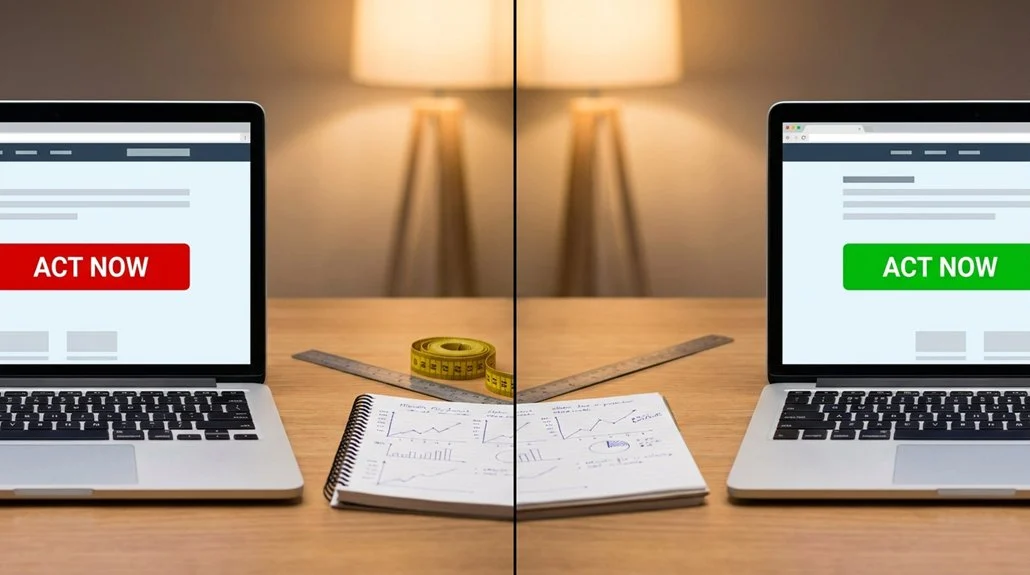
Even small changes to your website can shift how many leads you get. A/B testing helps you find what works by comparing two versions of the same element.
Start by testing these four things:
- Headlines and CTAs – Swapping “Get a trial” for “Free trial” lifted conversions by 11.3% in HubSpot data.
- CTA button placements – Some placements outperform others by up to 300%.
- Landing page designs – Analyzing layouts through testing can increase conversions by up to 24%.
- Form fields – Shorter forms drive higher completion rates, sometimes doubling results.
Use heatmaps from tools like Hotjar to study user experience on each page. They show where people click, scroll, and stop.
Test one element at a time. That’s how you optimize with confidence.
Frequently Asked Questions
How Do I Get More Leads on My Website?
- You need to focus on a few key areas.
- Start with SEO strategies to drive your target audience to your site.
- Build a strong landing page with a clear call to action.
- Use lead magnets to capture emails, then follow up with email marketing.
- Content marketing and social media build trust over time.
- Better user experience and conversion optimization turn more visitors into real leads.
What Are the 7 C’s of a Website?
The 7 C’s cover the core parts of your website.
- Context is your website design and layout.
- Content drives your content strategy and SEO tactics.
- Community builds trust with your audience targeting.
- Customisation improves user experience and conversion rates.
- Communication shapes your call actions.
- Connection links your platforms.
- Commerce handles sales.
Together, they support mobile optimisation and help analytics tools measure what’s working.
What Is the 5 Minute Rule for Leads?
- The 5 Minute Rule says you need to follow up with a lead within five minutes of them visiting your website.
- That’s your window. Miss it, and you’ll likely lose them. Your lead response time directly affects your conversion optimisation.
- Use automated tools, strong call to action prompts, and email marketing to act fast.
- Slow follow up strategies kill user engagement and hurt your lead nurturing efforts.
Can Chatgpt Generate Leads?
Yes, ChatGPT can generate leads. It uses conversational marketing and AI engagement tactics to talk with your website visitors in real time.
It collects contact details through personalised messaging and automated responses. It also gathers customer insights to improve your lead generation strategies.
Better user experience means more people stay on your site longer. Chatbot effectiveness turns casual visitors into real prospects.
Final Thoughts
Your website can generate more leads. You just need to fix the right things. Start with page speed and layout. Add clear CTAs and simple forms. Show testimonials and honest pricing. Then test what’s working and improve it. None of this is complicated. But it does require you to be deliberate. Small changes to the right elements can turn a site that’s losing leads into one that’s capturing them consistently.